
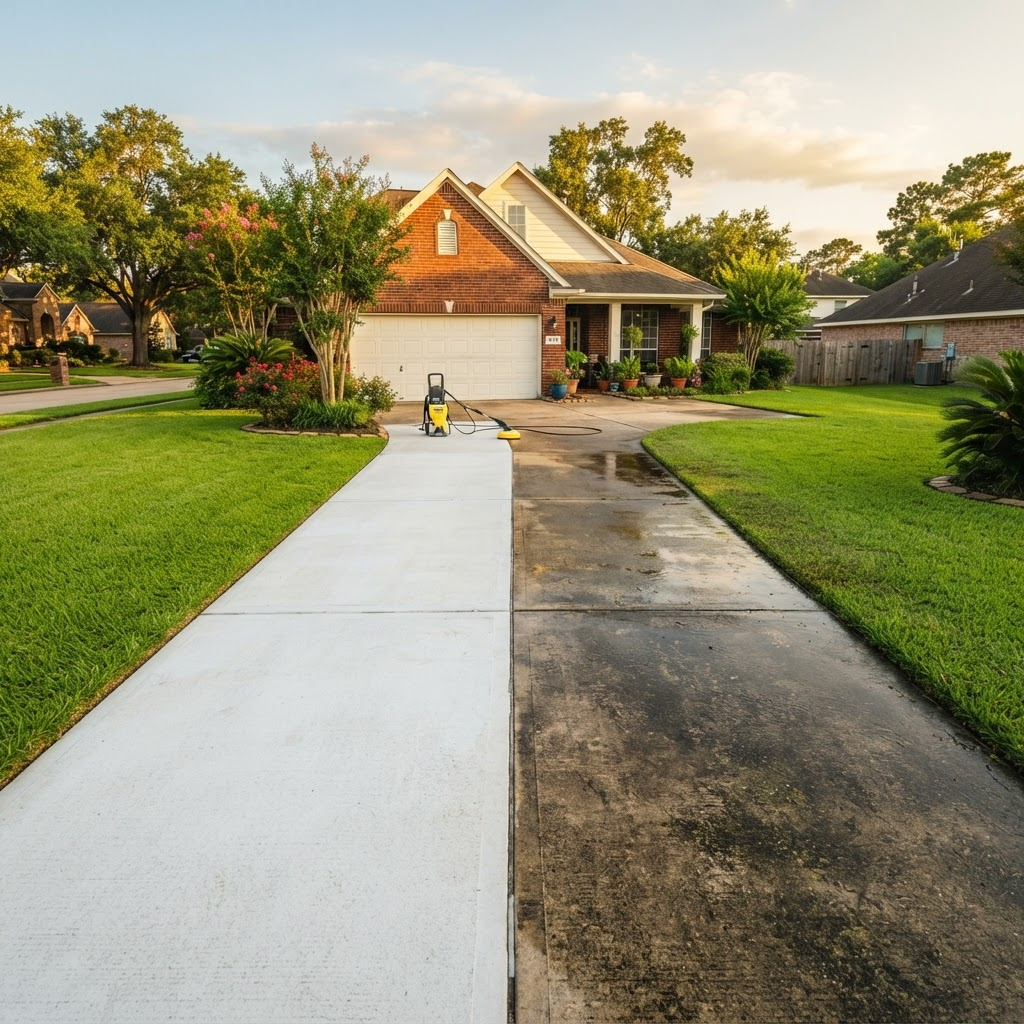
The Short Answer: Once Every 12 Months in Most Cases
For the average homeowner in Cypress, TX, a professional pressure washing once per year is the right maintenance interval for a concrete driveway under normal conditions. That single annual cleaning removes the full season of algae accumulation, clay staining, oil drips, and biological growth before any of it has a chance to penetrate deeply into the concrete's pore structure.
But "once a year" is the baseline — not the ceiling. Several factors specific to the Houston area push that number higher for many homes.
Why Houston Homeowners Need to Clean More Often Than the National Average
Most pressure washing advice you will find online is written for temperate or arid climates. The general guidance — "clean your driveway every one to two years" — reflects conditions in places like Phoenix or Denver, where biological growth is slow and humidity-driven staining is uncommon.
Cypress, TX is categorically different.
Humidity. The greater Houston area averages 75% relative humidity year-round. That sustained moisture creates a near-constant environment where algae, mold, and mildew can colonize concrete surfaces. In shaded driveways with tree canopy overhead, green algae can visibly re-establish within 4 to 6 months of a cleaning during the summer growing season.
Clay soil. Fort Bend and Harris County's expansive clay soil stains concrete a distinct orange-red after rain events. That clay runoff infiltrates the surface pores of your driveway and resists standard hosing — it requires professional pressure washing with a surfactant to lift fully.
Tree canopy. Established neighborhoods in Cypress — Bridgeland, Coles Crossing, Fairfield, Blackhorse Ranch — have mature oak, pine, and magnolia trees. Those trees deposit tannins, sap, and organic debris directly onto driveways throughout the year, creating dark staining that compounds season over season if not professionally removed.
Heat and UV exposure. South-facing driveways without tree cover see accelerated oxidation from UV exposure during Cypress's long, intense summers. That oxidation dulls the concrete surface and creates micro-roughness that traps more staining material with each passing month.
Factors That Increase Your Cleaning Frequency
Beyond the baseline annual clean, these conditions indicate you should schedule more frequently — typically every 8 to 10 months:
Significant tree canopy directly over the driveway. If you park under an oak or magnolia, tannin and sap deposits accumulate rapidly. The shading also slows drying after rain, which means the concrete stays wet longer — ideal conditions for biological growth.
Proximity to a lake, pond, or detention basin. Homes in communities like Towne Lake, Canyon Lakes West, or Cypress Creek Lakes sit near water features that increase localized humidity compared to drier sections of the same zip code. Lakefront-adjacent homeowners typically see algae re-establish 2 to 3 months earlier than interior-lot neighbors.
Light-colored or white concrete. Staining is always present — it is just less visible on darker concrete. Light-colored driveways make every algae bloom and clay streak immediately apparent, and the cosmetic impact on curb appeal is proportionally greater. Most light-concrete homeowners prefer a shorter cycle to maintain the visual impact of clean concrete.
Active HOA with exterior standards. Several Cypress communities maintain HOA standards that include driveway cleanliness. If your association does periodic exterior reviews, scheduling your cleaning 2 to 3 months before the review cycle keeps you comfortably ahead of any concerns.
Active oil staining from vehicles. If you or a household member has a vehicle with a slow oil leak, that organic material needs to be treated more frequently. Oil penetrates porous concrete quickly, and the longer it sits, the more difficult it becomes to fully lift. Addressing it early — before it has weathered through multiple seasons — keeps the removal process straightforward and the result cleaner.
Signs Your Driveway Is Overdue for a Cleaning
You do not always need to count months. These visual and tactile signs indicate your concrete needs professional attention regardless of when it was last cleaned:
- Green or black biological staining anywhere on the surface, particularly near expansion joints, along the edges, or beneath tree canopy
- A slippery or slightly tacky feeling when wet — this is algae in its early growth phase, before it becomes visually obvious
- Orange or rust-colored streaking along the driveway apron or curb approach after rain events (clay soil infiltration)
- Visible oil staining that has been present for more than one season
- Overall darkening of the concrete surface compared to its original appearance — this is the cumulative effect of biological growth, tannin staining, and environmental deposit that builds invisibly over time
What a Professional Cleaning Does That a Garden Hose Cannot
A standard garden hose operates at roughly 40 to 60 PSI — enough to rinse surface debris but nowhere near sufficient to dislodge embedded algae, lift clay staining from the pore structure, or sanitize the biological growth that causes recurring discoloration.
Professional pressure washing equipment operates at 3,000 to 4,000 PSI with heated water. The combination of pressure, temperature, and a biodegradable surfactant dwell time before the rinse removes staining that has worked its way below the surface — not just the material sitting on top of it.
The practical result: a professionally cleaned driveway looks noticeably brighter than one that has been regularly hosed down, because the cleaning goes deeper than any consumer equipment can reach.
Our Recommendation for Cypress Homeowners
- Baseline: Once per year, scheduled in early spring (March–April) before the peak algae growing season, or in early fall (September–October) after the summer's worst biological accumulation.
- Tree canopy or lakefront: Every 8 to 10 months.
- Light-colored concrete or active HOA: Every 8 months, timed 2 to 3 months before HOA review cycles.
- Oil staining present: Address immediately regardless of your regular schedule.
If you are not sure where your driveway falls, contact us for a free assessment. We will walk the surface with you, identify the staining types present, and give you an honest recommendation — not a sales pitch for more frequent service than your concrete actually needs.
Ready to Schedule?
Northrock Exteriors is based in Cypress, TX and serves Bridgeland, Fairfield, Towne Lake, Coles Crossing, Stone Gate, Blackhorse Ranch, Canyon Lakes West, Cypress Creek Lakes, and all surrounding communities.
[Get a free estimate](/contact) — we respond same day, Monday through Saturday.